History
Downtown San Jose is the oldest part of California’s oldest civil town. In a few dozen blocks between Julian Street and Interstate 280 it holds the plaza where the pueblo was laid out in 1797, the site of the first state capitol, a park mapped in 1848, the street where an iron light tower once stood, and a university that has been on the same square since 1871.

A short history of Downtown San Jose
Downtown San Jose is the oldest part of California’s oldest civil town. In a few dozen blocks between Julian Street and Interstate 280 it holds the plaza where the pueblo was laid out in 1797, the site of the first state capitol, a park mapped in 1848, the street where an iron light tower once stood, and a university that has been on the same square since 1871. This page tells that story in short, with a link to the source for every claim. For the full texts of the old books, see the reading list.
The first people
Before the Spanish arrived, the Santa Clara Valley was home to the Tamien, one of eight language groups of the Ohlone people [14]. Their name is on record from 1777 and comes from the place where the first Mission Santa Clara was built on the Guadalupe River, and the valley held dozens of Tamien-speaking villages [14].
A pueblo by the Guadalupe, 1777
On his 1776 expedition, Juan Bautista de Anza chose the sites of Mission Santa Clara and a pueblo in the Santa Clara Valley [1]. Lieutenant José Joaquín Moraga founded El Pueblo de San José de Guadalupe on November 29, 1777, the first town in Alta California that was not tied to a mission or a military post [1]. It was a farming settlement meant to feed the presidios of San Francisco and Monterey, and in 1778 it had 68 people [1].
The adobe and the plaza, 1797
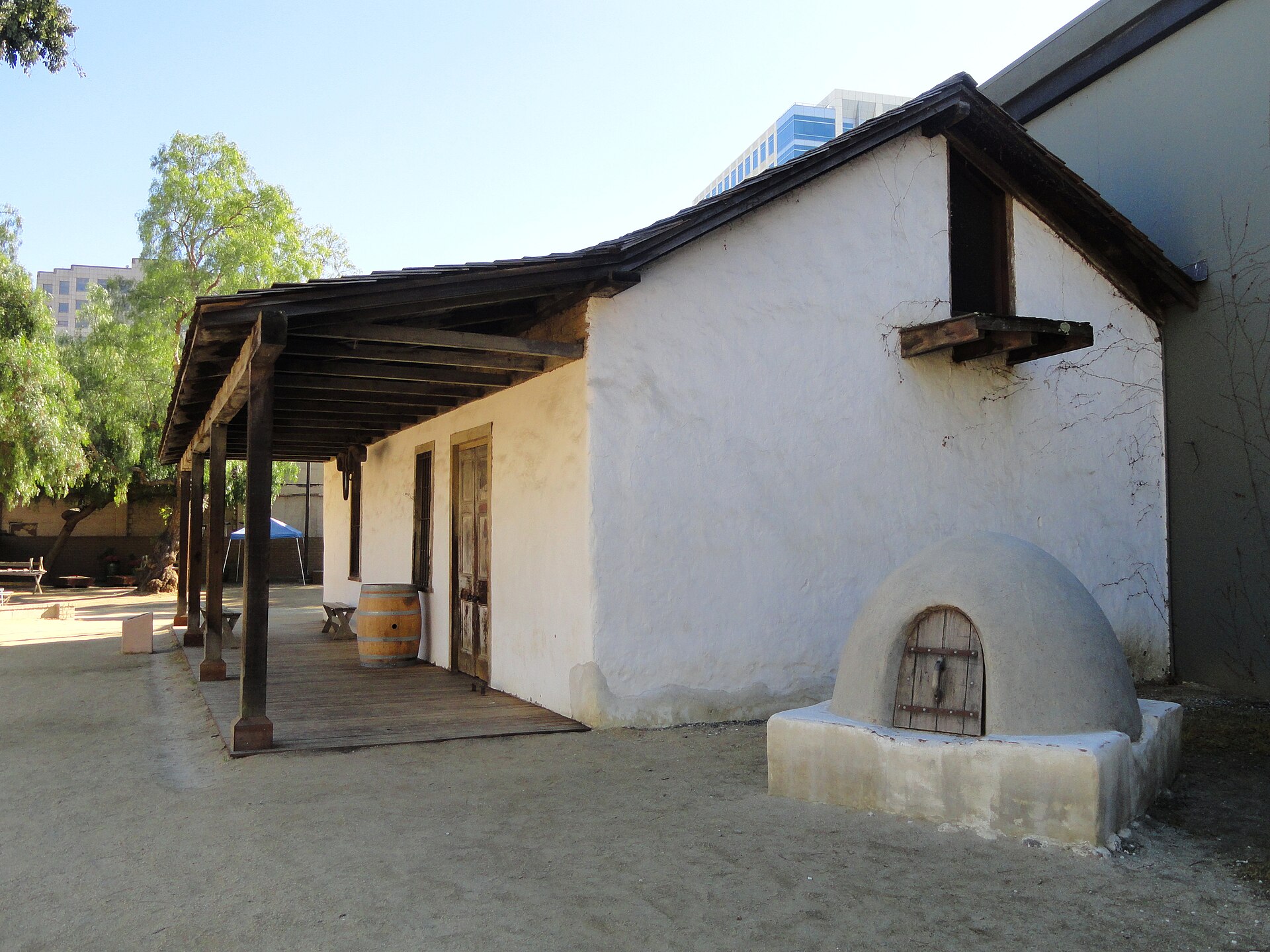
The first site, near today’s Hobson and San Pedro streets, flooded, and in 1797 the pueblo moved south to the area around a new plaza [1]. That plaza, laid out as the pueblo’s plaza mayor, is called the oldest public open space in Northern California [3]. The same year José Manuel Gonzales, one of the founding settlers, built the adobe house that still stands near San Pedro Square [4]. Luís María Peralta, the pueblo’s commissioner, lived there from 1808 until his death in 1851 [4]. The Gonzales/Peralta Adobe is the oldest building in San Jose and the last structure left from the pueblo [5].
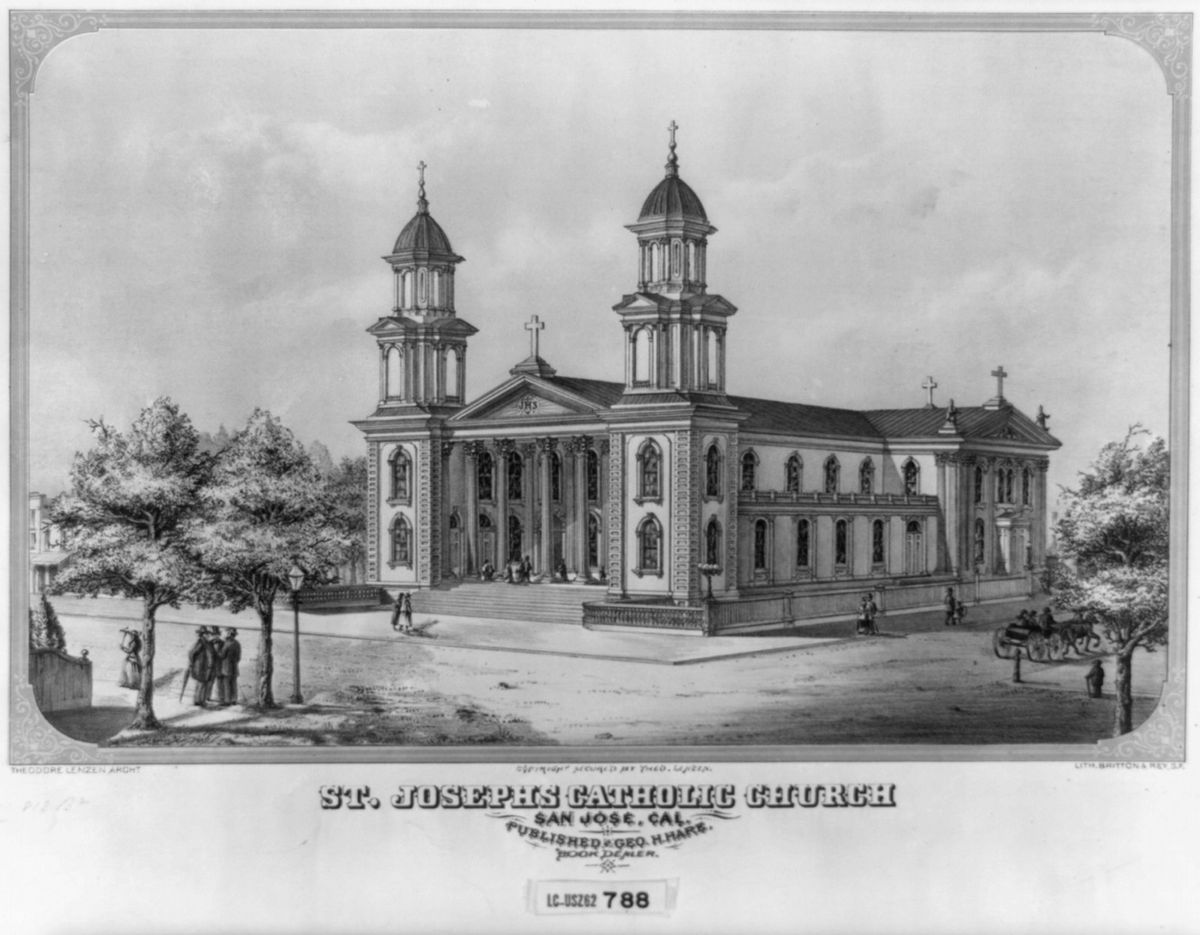
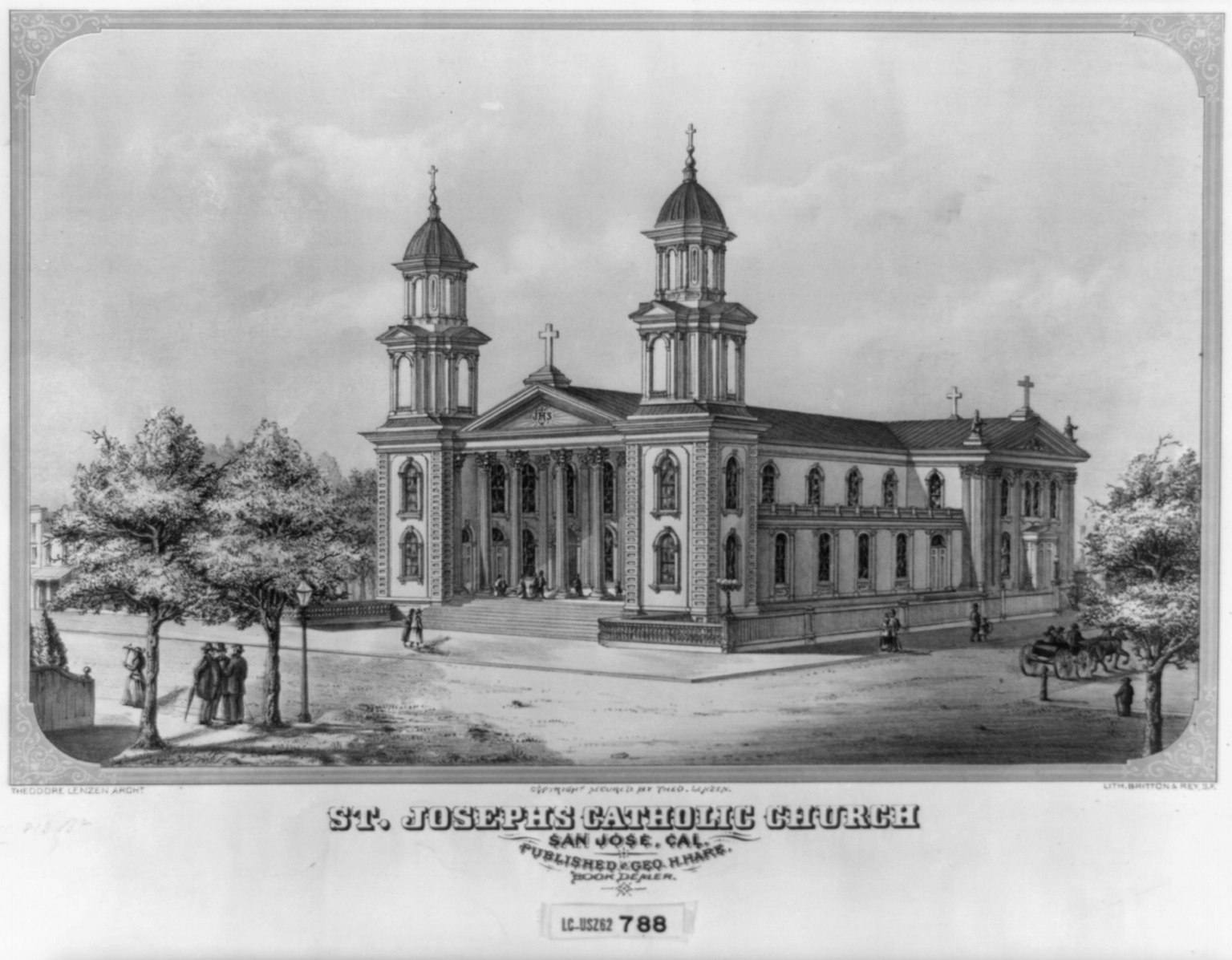
A church was built facing the plaza in 1803; on the same corner, the present Cathedral Basilica of St. Joseph was dedicated in 1877 and its dome finished in 1885 [15].
The flag and the first capital, 1846-1851
On July 11, 1846, Thomas Fallon’s small company of volunteers took the pueblo without bloodshed, and on July 14 he raised the American flag over its juzgado, the town hall and court [6]. Fallon later built a house across from the Peralta Adobe in 1855 and served as mayor [6].
When the travel writer Bayard Taylor rode in during 1849, he found adobe houses, tents and a few new clapboard buildings around “an open plaza, a quarter of a mile in length” [8]. San Jose was chosen as the seat of the new state government, and the first Legislature met there on December 15, 1849, in a two-story adobe on the east side of Market Plaza that the townspeople had bought for the purpose [7]. It became known as the Legislature of a Thousand Drinks, and it soon moved the capital away, accepting Mariano Vallejo’s offer of land at what is now Benicia [1]. The State House burned in 1853 [7]. A ring of palms around the state seal, the Circle of Palms, marks the site as California Historical Landmark No. 461 [9]. San Jose incorporated on March 27, 1850, with Josiah Belden as its first mayor [1].
Squares, a Chinatown and a light tower
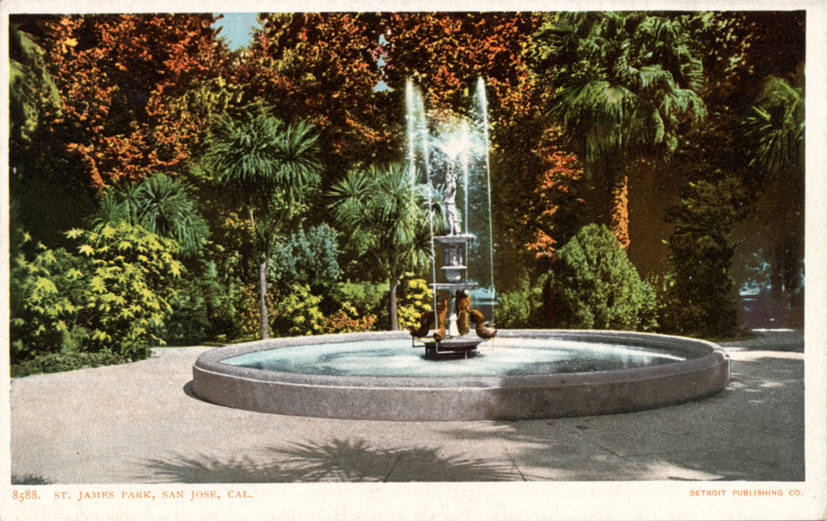
American surveyors laid out a street grid over the old pueblo paths, and Chester Lyman’s survey of 1848 set aside St. James Square [10] [18]. The square was landscaped in the late 1860s and was being called a park by 1885, after a fountain went in at its center [10]. In 1903 a statue of President William McKinley was unveiled where he had spoken two years earlier [10]. Trinity Episcopal Church, finished beside the square in 1863, is the oldest church building in continuous use in the city [28]. The State Normal School moved to Washington Square in 1871; it became San José State [16].
From 1866 a Chinatown grew up along Market Street beside the plaza, reaching about 1,400 people [11]. As anti-Chinese feeling peaked, the city council declared it a public nuisance, and on May 4, 1887, it was destroyed by fire; the next day the council approved a new City Hall for the plaza across the street [11]. That City Hall stood in the middle of the plaza from 1889 to 1958 [3]. In 2021 the city formally apologized for its part in the Chinatown’s destruction [23].
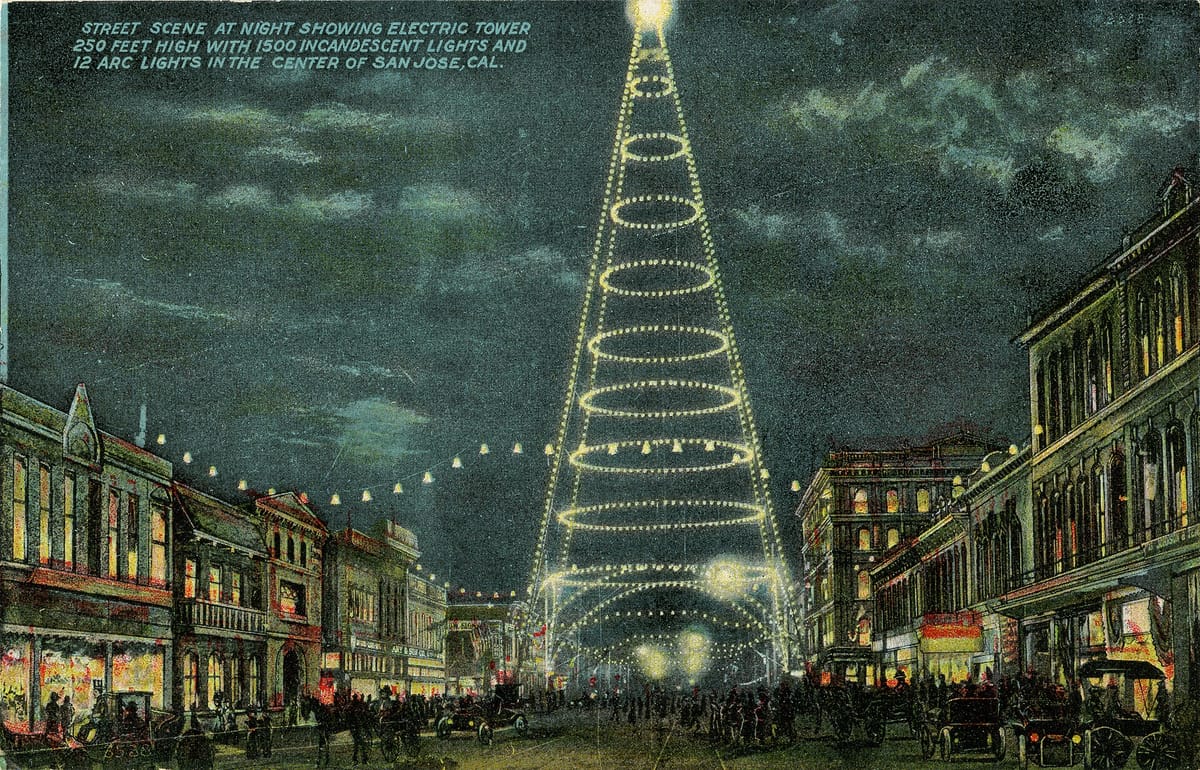
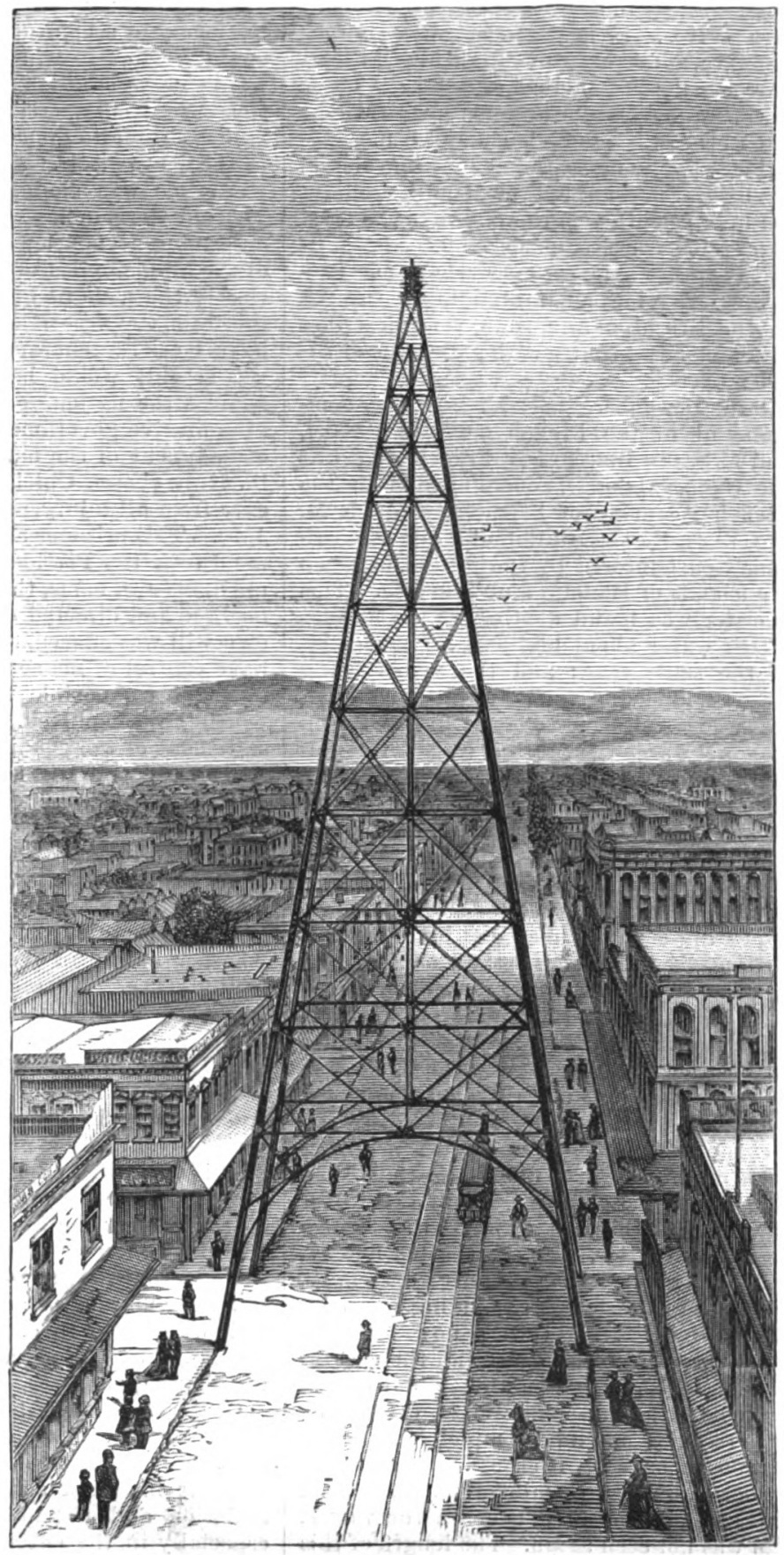
In 1881, at the urging of J. J. Owen of the San Jose Mercury, an iron tower 237 feet high, flagpole included, was raised over the crossing of Santa Clara and Market streets to light the town with arc lamps [12]. A newspaper of the day said it “stood astride her two principal streets” [13]. It lit the sky better than the streets, and after a storm damaged it in February 1915, winds brought it down on December 3, 1915 [12]. A writer of 1901 compared the city from above to a chessboard cut by Santa Clara and First streets, with the churches as queens and the electric masts as kings [27].
Towers, hotels and a hard century
After the 1906 earthquake, Edwardian, Neoclassical and Mission Revival buildings replaced damaged ones in the commercial core, which is now the Downtown Historic District [18]. The 14-story Bank of Italy Building of 1925-26 was San Jose’s first skyscraper, and until 1970 it was the tallest building between San Francisco and Los Angeles [17]. The Sainte Claire hotel opened in 1926, the California Theatre in 1927 and the Art Deco Hotel De Anza in 1931 [31] [32] [30].
Downtown also saw violence. In November 1933 a mob stormed the jail and lynched two men accused of kidnapping and killing Brooke Hart in St. James Park, an event described as the last public lynching in California [1] [10].
After 1950, city manager A. P. Hamann pushed San Jose outward, and the old downtown declined [2]. City Hall itself moved north to the Civic Center in 1958, and the old one in the plaza was demolished [19].
Redevelopment and the arts district
In the 1980s Mayor Tom McEnery and the San Jose Redevelopment Agency set out to rebuild downtown, sometimes demolishing old buildings for hotels, museums, theaters and parks [2]. Light rail through downtown opened in 1988 [10]. The plaza was renamed for César Chávez in 1993 [3]. Some old buildings were saved: in 2000 the 1911 Hotel Montgomery was rolled about 187 feet down South First Street to make room for a hotel tower [21].
South First Street, a busy shopping street in the late 1800s, had become a red-light district by the late 1970s; after adult businesses were zoned out in the late 1980s, clubs and galleries moved in and the area became known as SoFA [20]. The San Jose Arena, now SAP Center, opened in 1993 [29]. In the city’s 1880s Italian settlement by the Guadalupe River, the Little Italy San Jose group raised a 31-foot gateway arch in 2015 [25].
Today
City government came back downtown in 2005, when Richard Meier’s City Hall opened on East Santa Clara Street [19]. Christmas in the Park, which grew from Don Lima’s Nativity display and moved to the plaza in 1981, still fills it every December [24]. Because downtown lies under the approach to the airport, its towers are held to about 300 feet [26]. In 2026, after allegations against César Chávez, the city began choosing a new name for the plaza; city staff recommended Plaza de San Jose, and the council will decide [22].
Key dates
01
1777
A pueblo by the Guadalupe
José Joaquín Moraga founds El Pueblo de San José de Guadalupe on November 29. Source ↗
02
1797
The move to the plaza
After floods, the pueblo moves to the area around today’s plaza, and José Manuel Gonzales builds his adobe. Source ↗
03
1803
A church on the plaza
The first St. Joseph’s church is built where the cathedral basilica stands today. Source ↗
04
1846
The flag goes up
Thomas Fallon raises the American flag over the pueblo’s juzgado on July 14. Source ↗
05
1849
California’s first capital
The first Legislature meets in the State House on Market Plaza on December 15. Source ↗
06
1871
Washington Square
The State Normal School, today San José State, moves to San Jose. Source ↗
07
1881
The light tower
J. J. Owen’s iron tower of arc lights is dedicated over Santa Clara and Market streets on December 13. Source ↗
08
1887
Chinatown burns
The Market Street Chinatown is destroyed by arson on May 4; the city apologizes in 2021. Source ↗
09
1926
The first skyscraper
The 14-story Bank of Italy Building is finished at First and Santa Clara streets. Source ↗
10
1958
City Hall leaves the plaza
The City Hall of 1889 in the plaza is demolished as city offices move north. Source ↗
11
1988
Paseo and light rail
The Paseo de San Antonio opens to walkers, and light rail lines through downtown are completed. Source ↗
12
1993
The arena opens
The San Jose Arena, now SAP Center, is completed for the Sharks. Source ↗
13
2005
City Hall comes back
Richard Meier’s City Hall opens on East Santa Clara Street on October 15. Source ↗
14
2026
A new name for the plaza
The city begins renaming Plaza de César Chávez; staff recommend Plaza de San Jose. Source ↗
Sources
1. History of San Jose, California — Wikipedia
2. Downtown San Jose — Wikipedia
3. Plaza de César Chávez — Wikipedia
5. Gonzales/Peralta Adobe – Fallon House Historic Site — History San José
7. The History of San José and Surroundings (Frederic Hall, 1871) — Internet Archive
8. Eldorado, or Adventures in the Path of Empire (Bayard Taylor, 1850) — Internet Archive
9. Circle of Palms Plaza — Wikipedia
10. St. James Park (San Jose, California) — Wikipedia
11. Market Street Chinatown — Wikipedia
12. San Jose electric light tower — Wikipedia
13. Looking Back: San Jose’s Electric Light Tower — San José Public Library
15. Cathedral Basilica of St. Joseph (San Jose, California) — Wikipedia
16. San Jose State University — Wikipedia
17. Bank of Italy Building (San Jose, California) — Wikipedia
18. Downtown Historic District (San Jose, California) — Wikipedia
19. San Jose City Hall — Wikipedia
21. Hotel Montgomery (San Jose, California) — Wikipedia
22. San Jose officials to weigh new name for downtown plaza — San José Spotlight, 2026
23. San Jose formally apologizes for the arson of its Chinatown more than a century ago — NBC News, 2021
24. Walk Around Town: Christmas in the Park — San José Public Library
25. About Us — Little Italy San Jose
26. San Jose, California — Wikipedia
27. Reminiscences of Santa Clara Valley and San Jose (Amaury Mars, 1901) — Internet Archive
28. Trinity Episcopal Cathedral (San Jose, California) — Wikipedia
Further reading
Eldorado, or Adventures in the Path of Empire, Bayard Taylor (1850) — public domain, free to read online
The History of San José and Surroundings, with Biographical Sketches of Early Settlers, Frederic Hall (1871) — public domain, free to read online
Picturesque San José and Environments, H. S. Foote, C. A. Woolfolk (1893) — public domain, free to read online
Reminiscences of Santa Clara Valley and San Jose, Amaury Mars (1901) — public domain, free to read online
San José (San Hosay), Santa Clara County, California, San Jose Chamber of Commerce (1904) — public domain, free to read online
History of Santa Clara County, California, Eugene T. Sawyer (1922)
History of Santa Clara County, California, J. P. Munro-Fraser (1881)
Seeing San Jose and the Santa Clara Valley, Guide Publishing Company (1904)
Clyde Arbuckle’s History of San Jose, Clyde Arbuckle (1986) — borrow it from the Internet Archive
History of San Jose, California, William F. James, George H. McMurry (1933) — borrow it from the Internet Archive